“Are we really paying the right amount for maintenance every month?” If you have ever asked yourself this, you are not alone.
In many companies, system maintenance contracts simply roll over year after year. But as IT budgets come under closer scrutiny in 2026, making maintenance costs visible and optimizing them has become a management priority. This guide breaks down how maintenance costs are structured, typical market rates, in-house vs. outsourced options, and practical ways to cut costs without sacrificing quality.
What you will learn
- The three cost layers behind every maintenance budget
- Typical monthly maintenance rates by system size (in-house, domestic outsourcing, offshore)
- A six-factor comparison of in-house vs. outsourcing — including hidden costs
- Five traps that inflate maintenance costs, and three ways to reduce them while protecting quality
1. What Are You Really Paying For?
Maintenance feels expensive mainly because its cost structure is hard to see. In practice, maintenance costs fall into three layers.
| Layer | What it covers | Typical share |
|---|---|---|
| People | Engineer hours, on-call coverage, skills development | 55–65% |
| Infrastructure | Servers and cloud, licenses, monitoring tools | 20–30% |
| Management | Documentation, change management, reporting, QA | 10–20% |
Key takeaway
2. Market Rates for System Maintenance by System Size
To help you judge whether your costs are high or low, here are indicative monthly rates by system size, based on the Japanese market.
| System size | In-house | Domestic outsourcing | Offshore outsourcing | Savings potential |
|---|---|---|---|---|
| Small (up to 500K LOC) | $5,500–$10,500 | $4,200–$8,400 | $2,100–$4,200 | Up to 60% |
| Medium (500K–3M LOC) | $14,000–$35,000 | $10,500–$28,000 | $5,600–$14,000 | Up to 55% |
| Large (3M+ LOC) | $35,000–$140,000 | $28,000–$105,000 | $14,000–$49,000 | Up to 50% |
| SaaS / cloud-based | $3,500–$14,000 | $2,800–$10,500 | $1,400–$5,600 | Up to 60% |
*Indicative figures based on Japanese market trends as of 2026, converted from JPY at approximately ¥143 per USD. Actual costs vary with system complexity, technology stack, and SLA requirements.
The option many companies overlook
3. In-House vs. Outsourcing: Six Factors Compared
“Outsourcing is expensive; in-house is cheaper.” This assumption holds many companies back. Once hidden costs are included, the picture often flips.
| Factor | In-house | Domestic outsourcing | Offshore outsourcing |
|---|---|---|---|
| Monthly cost (medium system) | $14,000–$35,000 | $10,500–$28,000 | $5,600–$14,000 |
| Response speed | ◎ Immediate | ○ Depends on SLA | ○ Guaranteed via SLA design |
| Technology coverage | △ Depends on individuals | ○ Broad | ◎ Wide range of stacks |
| Talent risk | ✕ Knowledge lost when people leave | ○ Team-based | ○ Team-based |
| Scalability | ✕ Hiring takes time and money | ○ Flexible | ◎ Most flexible |
| Communication | ◎ Instant, internal | ○ Local-language support | ○ Dedicated Bridge SE |
Watch out for the hidden costs of in-house teams
4. Five Traps That Inflate Maintenance Costs
Even systems of the same size can carry very different maintenance bills. Check whether any of these apply to you.
Missing documentation drives up investigation time
When specifications are outdated or missing, every fix starts with reverse-engineering the code. Investigation alone can consume 30–40% of total effort.
Out-of-scope “quick favors” add up
Small “while you’re at it” requests accumulate and quietly appear on the monthly invoice. Vague scope definitions are a red flag.
Legacy technology carries a skills premium
Technologies with a shrinking talent pool, such as COBOL or VB6, can command 2–3× the usual engineer rate. This is technical debt showing up as cost.
Over-engineered SLAs act as expensive insurance
Requirements like “24/7 response within 15 minutes” can multiply costs. SLAs should reflect actual business impact.
Vendor lock-in leads to take-it-or-leave-it pricing
When the original developer also controls maintenance, the lack of alternatives often leads to inflated pricing. Owning your source code rights and documentation is essential.
5. The Cost-Reduction Formula: What to Cut, and How
Reducing maintenance cost is not just about switching to a cheaper vendor. There are three structural approaches that lower costs while maintaining quality. 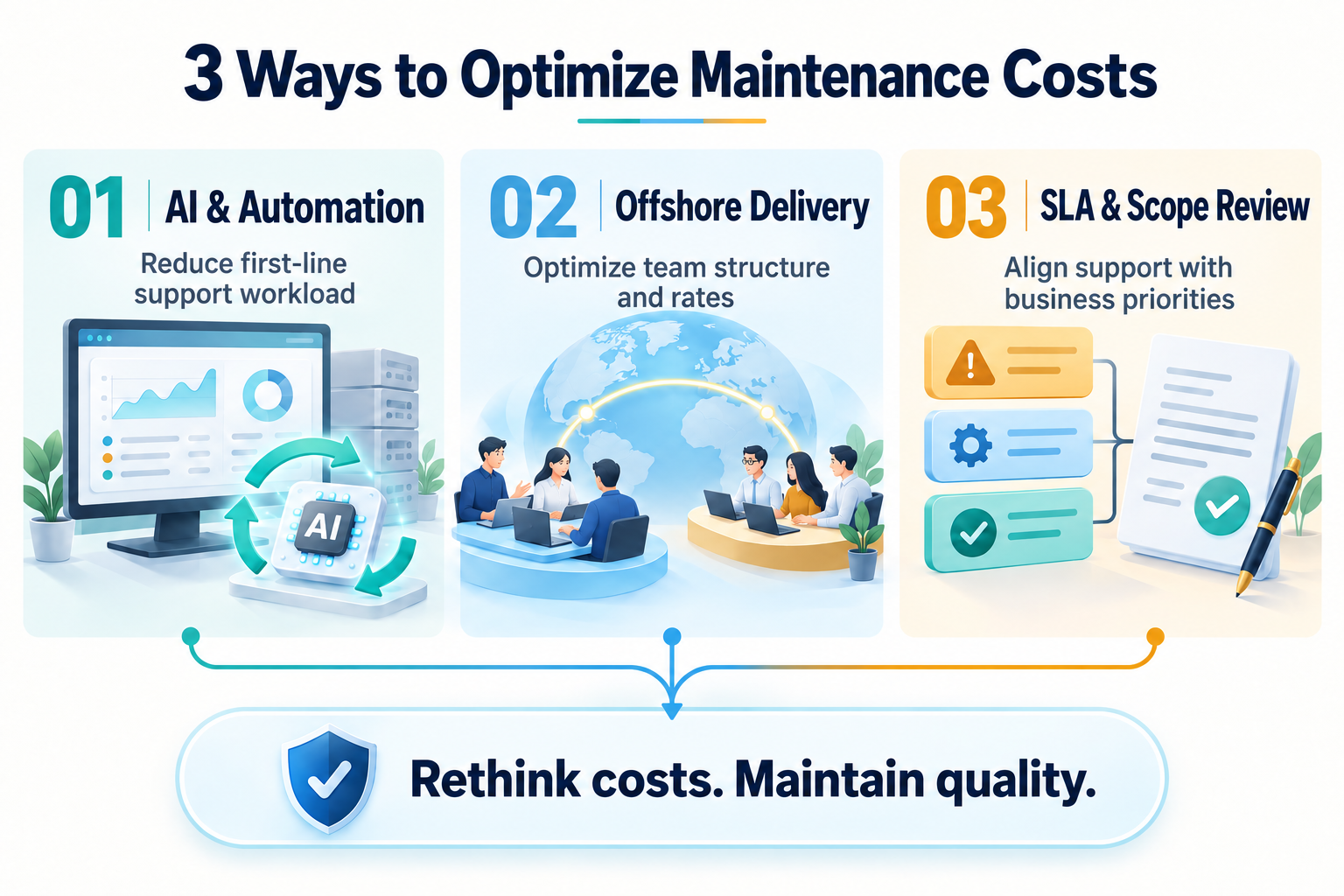
Approach 1
Automate L1 work with AI
Automate monitoring, alerting, and log analysis with the AI/ML features of tools such as Datadog or New Relic, significantly reducing manual first-line (L1) effort.
Estimated savings
10–30% lower monthly cost
Approach 2
Optimize engineer rates with offshore delivery
Offshore partners in countries such as Vietnam can deliver L2–L3 support at roughly 30–50% of domestic rates, with a Bridge SE safeguarding quality and communication.
Estimated savings
30–50% lower monthly cost
Approach 3
Redesign SLAs and scope
Move from “everything at the same level” to tiered response levels. Resetting SLAs into Critical / High / Medium removes the cost of over-servicing.
Estimated savings
10–20% lower monthly cost
Combining all three
6. Case Study: Cutting Maintenance Costs for a Mid-Sized Web System
Company A, a manufacturer with 500 employees, had outsourced all maintenance to a domestic system integrator. It switched to BAP’s offshore maintenance service combined with AI-based monitoring.
Before: domestic system integrator
Monthly cost
~$24,500
SLA
24/7, response within 1 hour (all incidents)
Annual cost
~$294,000
After: BAP offshore maintenance + AI monitoring
Monthly cost
~$11,200
SLA
3 tiers (Critical: 1 hr / High: 4 hrs / Medium: 1 business day)
Annual cost
~$134,400
~$159,600 saved per year (–54%)
with quality and availability maintained
7. Three Checks Before You Renegotiate Maintenance
Cutting costs too quickly can damage quality. Before making changes, make sure you have covered these three points.
CHECK 1
Audit your current scope
Document exactly what is and is not covered. Simply eliminating informal, unplanned work can lower costs on its own.
CHECK 2
Run a business impact analysis (BIA)
Classify systems by how badly an outage would hurt the business, and design SLAs to match.
CHECK 3
Quantify transition risk
Estimate handover time, risk, and cost of switching vendors, then weigh them against the expected savings.
Frequently Asked Questions
Q. How do I know if my maintenance costs are reasonable?
A. Compare them with market rates for systems of similar size, then check whether the cost breakdown (people, infrastructure, management) matches the scope and SLA you actually receive.
Q. Will quality drop if we move maintenance offshore?
A. Not if the transition is planned well. With an adequate handover period, solid documentation, and clearly written SLAs, quality can be maintained. A Bridge SE serves as your point of contact throughout.
Q. Can we review costs while still under contract with our current vendor?
A. Yes. Start with an assessment of your current scope and costs, then plan a phased transition timed with your contract renewal.
Summary: Restructure Maintenance Costs, Don’t Just Cut Them
- About 60% of maintenance cost is people — who does the work, and where, is your biggest lever.
- Hidden in-house costs, excessive SLAs, and legacy skill premiums drive costs up.
- Combining AI automation, offshore delivery, and SLA redesign can cut costs by up to 55–60% while protecting quality.
Optimizing maintenance is not about cutting corners — it is about restructuring your cost base the right way. Address the structural issues one by one, and significant savings become achievable without compromising quality.
Is your maintenance budget right-sized? Get a free assessment from BAP
We will review your current maintenance contract and provide a free cost assessment with optimization recommendations. Even if you just want to know whether your current costs are reasonable, we are happy to help.