As digital transformation (DX) continues to reshape the manufacturing industry, more companies are considering Manufacturing Execution Systems (MES) to improve production management, quality control, and equipment monitoring.
However, many manufacturers face significant challenges when taking their first steps toward factory digitalization:
- High initial investment costs associated with MES implementation
- Continued reliance on Excel spreadsheets and paper-based records
- Production, quality, and equipment data scattered across multiple systems
- Uncertainty about which processes to digitalize first
- Difficulty estimating the return on investment (ROI)
But does starting your factory’s digital transformation really require a large-scale MES implementation?
Not necessarily.
The key is not how large or sophisticated the system is, but how effectively it addresses your factory’s actual challenges through a practical, step-by-step approach.

1. Why Can MES Implementation Require a Significant Investment?
A Manufacturing Execution System (MES) supports various manufacturing operations, including production scheduling and execution, progress tracking, quality management, equipment monitoring, and traceability.
While MES can provide centralized visibility and control over manufacturing operations, implementation costs can vary significantly depending on the project scope and integration requirements.
Several factors influence the overall investment:
- Integration with existing systems: Connecting MES with ERP, production management software, and other business applications
- Equipment data collection: Integrating PLCs, sensors, and Industrial IoT (IIoT) devices
- Process customization: Adapting the system to factory-specific workflows and operational requirements
- Software customization: Developing features tailored to unique manufacturing needs
- Deployment and maintenance: Employee training, data migration, system maintenance, and technical support
Implementing all these capabilities simultaneously can increase project complexity, extend deployment timelines, and require substantial upfront investment.
Therefore, before investing in MES, manufacturers should first identify which operational problems they need to solve and which capabilities are truly necessary.
2. The First Step in Factory DX Is Not Software Implementation, but Production Visibility
Consider some common challenges faced by manufacturing facilities.
Production Management
Production results are manually entered into Excel spreadsheets. Managers must wait for employees to compile reports before they can assess daily production progress.
Quality Management
Defect records and root causes are tracked through paper documents or separate spreadsheets, making it difficult to quickly identify quality trends across products and processes.
Equipment Management
Machine operating hours and downtime reasons are not consistently recorded, limiting visibility into the equipment issues affecting productivity.
Inventory Management
Raw materials, work-in-progress (WIP), and finished goods are managed across multiple files, creating discrepancies between production and management teams.
Solving these challenges does not always require implementing every MES feature from the beginning.
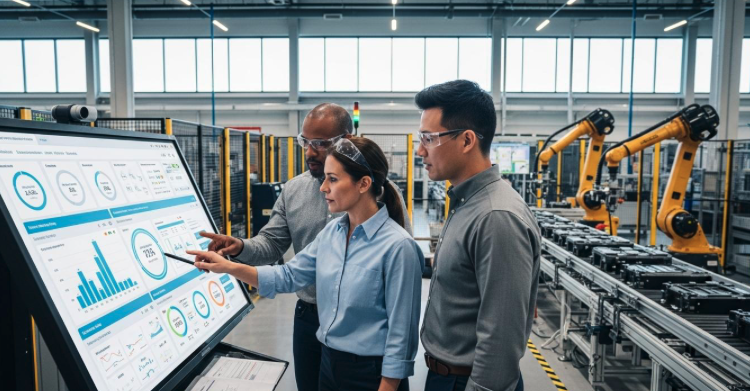
In many cases, consolidating existing Excel data and equipment information into a centralized dashboard can already help managers understand factory operations, reduce reporting effort, and identify potential issues earlier.
The first step in factory digital transformation is not digitalizing everything at once. It is creating the visibility needed to understand what is actually happening on the factory floor.
3. Start Small: A Four-Step Approach to Factory Digital Transformation
Rather than launching a large-scale digital transformation project immediately, manufacturers can adopt a phased approach based on operational priorities and measurable results.
STEP 1 | Organize and Centralize Existing Data
Begin by reviewing information currently managed through Excel spreadsheets, paper forms, and existing software systems.
Identify essential data such as production output, quality results, equipment operating status, and inventory levels.
Then, gradually standardize and consolidate this information to establish a foundation for monitoring and analysis.
Paper-based records can also be digitalized through electronic forms or other appropriate data-entry solutions.
STEP 2 | Visualize Operations Through Dashboards
Once data is centralized, manufacturers can build dashboards to monitor key operational indicators, including:
- Actual production output versus planned targets
- Machine operating status and downtime
- Defect counts and defect rate trends
- Productivity across production lines and processes
- Raw material, WIP, and finished goods inventory
These dashboards help managers monitor factory performance more efficiently and support earlier identification of operational issues.
Real-time visibility may also be achieved when appropriate data collection and integration mechanisms are in place.
STEP 3 | Digitalize and Automate Priority Processes
After gaining visibility into factory operations, manufacturers can identify processes where digitalization is likely to deliver the greatest value.
Examples include:
- Automated production data collection
- Digital quality inspection records
- Machine downtime alerts
- Electronic work instructions and progress tracking
- Automated inventory updates
By implementing improvements in stages, companies can evaluate results before expanding their investment.
STEP 4 | Expand MES Capabilities and Integrate with ERP
As operational requirements become more complex, manufacturers can introduce additional MES capabilities, enhance traceability, or integrate factory operations with ERP systems.
Instead of deploying every feature at once, companies can expand their digital infrastructure according to actual business needs.
However, data structures and system architecture should be designed with future scalability and integration in mind from the beginning.
4. What Are the Benefits of a Phased Factory DX Approach?
1. Better Control Over Initial Investment
Rather than investing in a comprehensive factory-wide system immediately, manufacturers can focus their budgets on high-priority processes.
This makes it easier to manage initial costs and allocate resources based on operational needs.
2. Reduced Disruption to Factory Operations
A phased implementation allows employees to gradually adapt to new tools and workflows without requiring major changes across the entire factory at once.
3. Measurable Results Before Further Investment
Manufacturers can track indicators such as reporting time, defect rates, machine downtime, and productivity to evaluate the impact of each improvement.
These results provide a stronger foundation for future investment decisions.
4. A Foundation for MES and AI Adoption
Establishing reliable data collection and management processes can prepare manufacturers for future MES implementation, ERP integration, advanced analytics, and AI-powered applications.
However, starting small should not mean building disconnected systems. Data standardization and integration planning remain essential for long-term scalability.
5. When Is a Full MES Implementation the Better Choice?
Although a phased approach offers several advantages, it is not suitable for every manufacturing environment.
Some factories may benefit from implementing a comprehensive MES from the beginning, particularly when they require:
- Strict production history tracking and product traceability
- Centralized production execution and performance management across multiple processes
- Real-time integration between ERP and manufacturing operations
- Standardized production management across multiple factories
The objective is not simply to choose the least expensive solution, but to determine which system capabilities are necessary to meet operational requirements and deliver sustainable business value.
6. How BAP Supports Factory Digital Transformation
At BAP, we support manufacturing companies in developing digital solutions aligned with their existing operations and long-term business objectives.
Our areas of support include:
- Digitalization of Excel-based and paper-based workflows
- Centralization of production, quality, and equipment data
- Production monitoring dashboards and data visualization
- MES development and implementation support
- ERP and existing system integration
- Industrial IoT data collection and analysis
By leveraging our development capabilities in Japan and Vietnam, BAP helps manufacturers evaluate their current challenges, identify priority areas, and develop practical implementation approaches.
Digital transformation can begin with a single production line, a specific management process, or a particular set of operational data.
Results can then be evaluated before expanding the solution across additional processes or facilities.
Conclusion | Factory DX Does Not Have to Start with a Large-Scale Investment
Successful factory digital transformation does not necessarily require implementing an expensive system from day one.
It begins with understanding operational challenges, making better use of existing data, and improving visibility into manufacturing activities.
From there, companies can gradually introduce new capabilities based on measurable improvements and evolving business requirements.
The goal of factory DX is not simply to implement software. It is to improve productivity, quality, and operational efficiency.
Are you facing challenges such as:
- Managing production data through Excel spreadsheets or paper documents?
- Limited visibility into real-time factory operations?
- Uncertainty about where to begin with MES implementation?
BAP is ready to support your digital transformation journey, starting with the challenges that matter most to your factory.
Start by understanding your factory’s current challenges and identifying the right first step toward digital transformation.