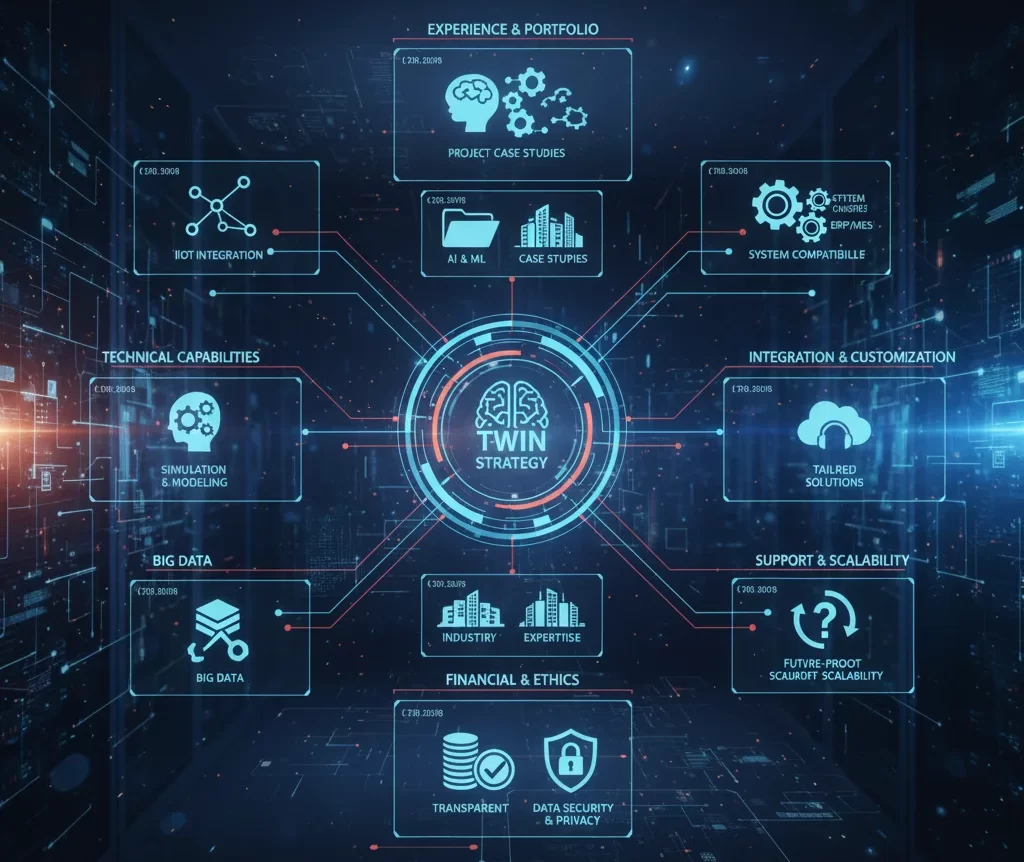
Today’s IT systems are under increasing pressure from complex and constantly evolving cybersecurity threats. A single minor vulnerability can become the root cause of operational disruption, financial loss, and serious damage to a company’s reputation. Therefore, System Security Maintenance is no longer merely a technical maintenance activity—it has become a critical strategy in IT governance and system protection. This article explores common security risks, effective defense strategies, and the O&M Services Security solutions provided by BAP Software.
1. Why Is System Security Maintenance Essential?
As digitalization accelerates, IT systems have become the backbone of modern enterprises. Alongside growth opportunities, however, cybersecurity threats are increasing rapidly in both frequency and sophistication. Implementing System Security Maintenance—the continuous maintenance and protection of system security—is no longer optional; it is a fundamental requirement.
Increasingly Sophisticated Threats
Ransomware attacks: Hackers encrypt system data and demand ransom, causing severe operational disruption.
Phishing & Social Engineering: Employees are deceived into granting access, enabling attackers to exploit sensitive data.
Advanced Persistent Threats (APT): Targeted attacks that stealthily infiltrate and remain in systems for months.
Zero-day exploits: Exploitation of unpatched vulnerabilities in software or operating systems.
Common factor: A single weak link—whether a server, application, human factor, or internal network—can expose the entire system to risk.
Impact of Inadequate System Security Maintenance
Operational disruption: Production or business activities may halt for hours or days, leading to revenue loss.
Data loss: Customer information, financial data, and intellectual property may be leaked or stolen.
Reputational damage: Loss of trust from customers and partners, with long-term brand impact.
Regulatory violations: Standards such as GDPR (EU), NIST (US), and ISO/IEC 27001 require strong data protection. Non-compliance can result in multi-million-dollar fines.
Benefits of Implementing System Security Maintenance
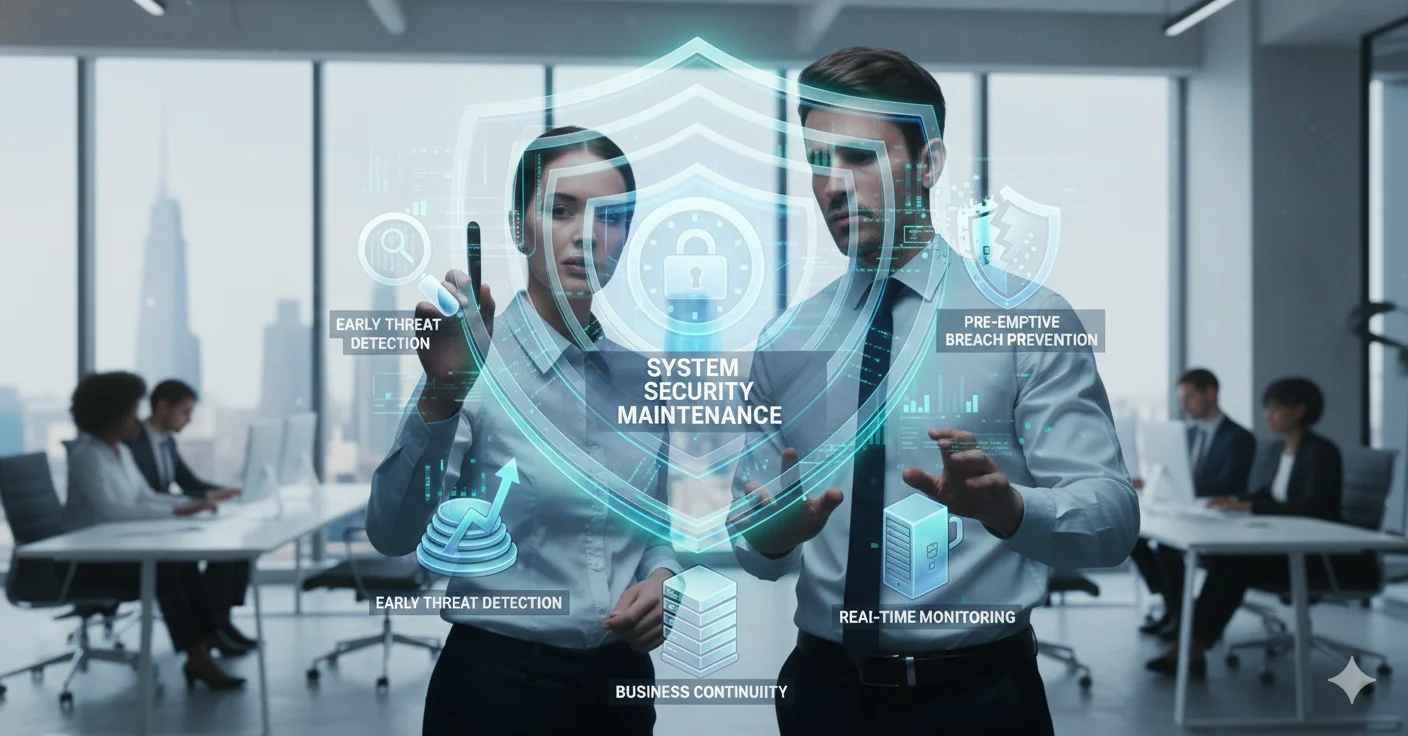
Early detection & rapid response through continuous monitoring.
Reduced incident recovery costs: Preventive maintenance costs far less than post-breach remediation (IBM estimates the average cost of a data breach at ~USD 4.5 million).
Business Continuity Assurance: Systems remain available with minimal downtime.
Regulatory compliance: Meeting international security standards enhances credibility with global partners.
Increased trust: Customers gain confidence when their data and transactions are well protected.
Looking toward 2025 and beyond, System Security Maintenance is not only a risk-prevention measure but also a foundation for sustaining competitive advantage and ensuring secure, continuous, and resilient system operations.
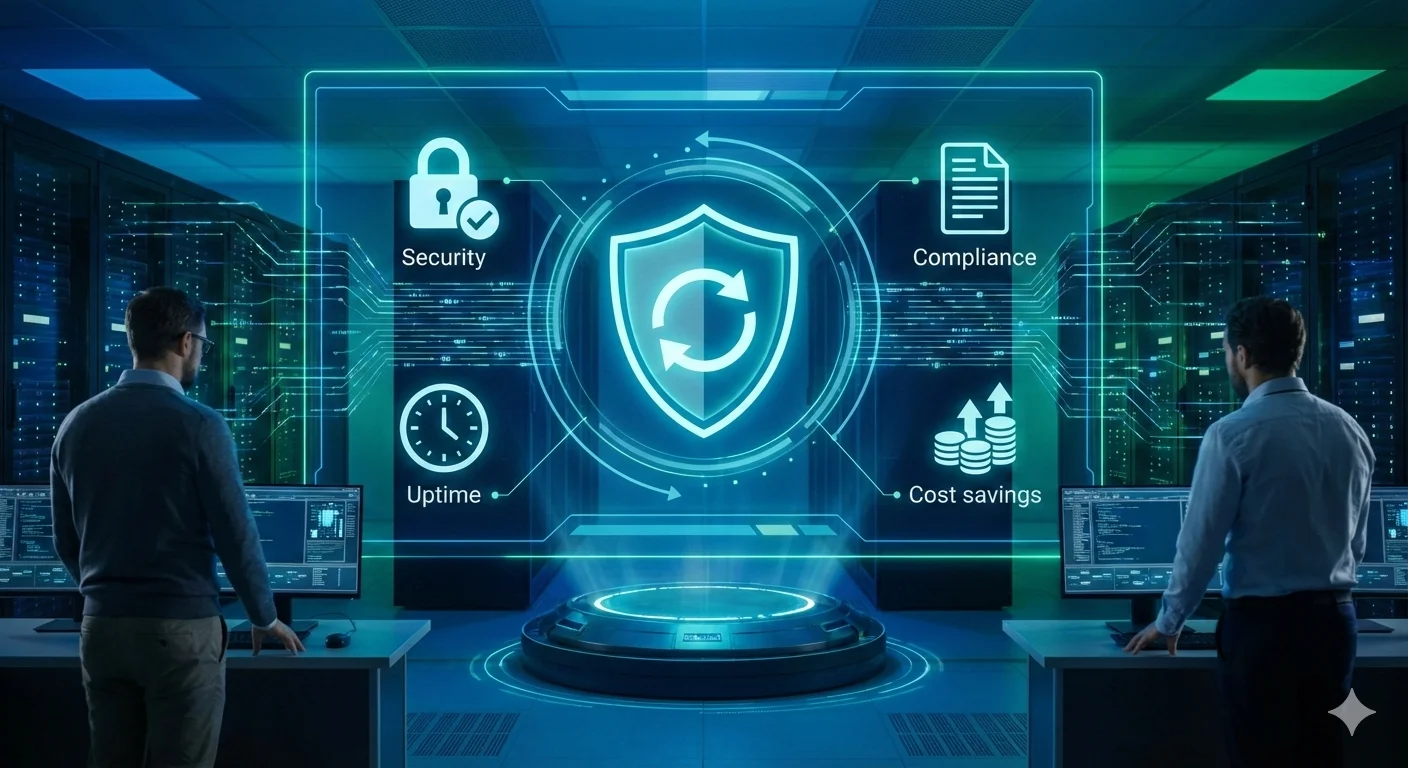
Những lý do doanh nghiệp cần System Security Maintenance. Nguồn: QNITrade
2. Common Risks in System Security
Even with significant investment in IT infrastructure, enterprises still face common security risks. Understanding these risks is the first step toward building an effective System Security Maintenance strategy.
Risks from Software & Operating Systems
Security vulnerabilities: Applications and operating systems frequently reveal new vulnerabilities. Without timely patching, attackers can exploit them to gain access.
Example: The Log4j vulnerability (2021) impacted millions of systems worldwide.Outdated software: Many organizations continue to use legacy systems (e.g., Windows Server 2008, SQL Server 2012) that no longer receive security updates.
Cyber Attacks
DDoS (Distributed Denial of Service): Attackers flood servers with requests, causing service disruption.
Ransomware: Data is encrypted and ransom is demanded—this threat has surged significantly between 2022 and 2025.
Man-in-the-Middle (MitM): Attackers intercept data transmission between users and servers to steal sensitive information.
Brute-force / Credential stuffing: Automated attempts to guess passwords until access is gained.
Human Factor Risks
Lack of security awareness: Employees fall victim to phishing emails or malicious links, enabling system compromise.
Insider threats: Employees may intentionally or unintentionally leak data (e.g., copying to USB devices or mis-sending emails).
Poor access management: Dormant accounts and improper privilege assignments create exploitable entry points.
Infrastructure & Device Risks
Insecure IoT devices: Cameras, sensors, and other IoT devices are easily compromised if not properly secured.
Endpoints: Laptops and smartphones used for remote work without patches or antivirus software become attack vectors.
Public Wi-Fi networks: Employees working over unsecured networks risk data interception.
Data & Compliance Risks
Customer data leakage: Caused by insecure backups or cloud misconfigurations.
Lack of encryption: Plain-text data transmission is highly vulnerable to interception.
Regulatory non-compliance: Failure to meet standards such as GDPR (EU), PDPA (Singapore), ISO/IEC 27001 can result in severe penalties.
Real-World Examples
Colonial Pipeline (US, 2021): A ransomware attack shut down fuel supply systems, triggering an energy crisis and causing losses of hundreds of millions of USD.
Honda (Japan, 2020): Ransomware disrupted global production lines.
Vietnamese logistics companies (2023): Customer data leaks caused by cloud misconfiguration.
Security risks can originate from technology, people, data, and infrastructure. Without continuous System Security Maintenance—including assessment, patching, monitoring, and security training—organizations remain highly vulnerable to cyber attacks.
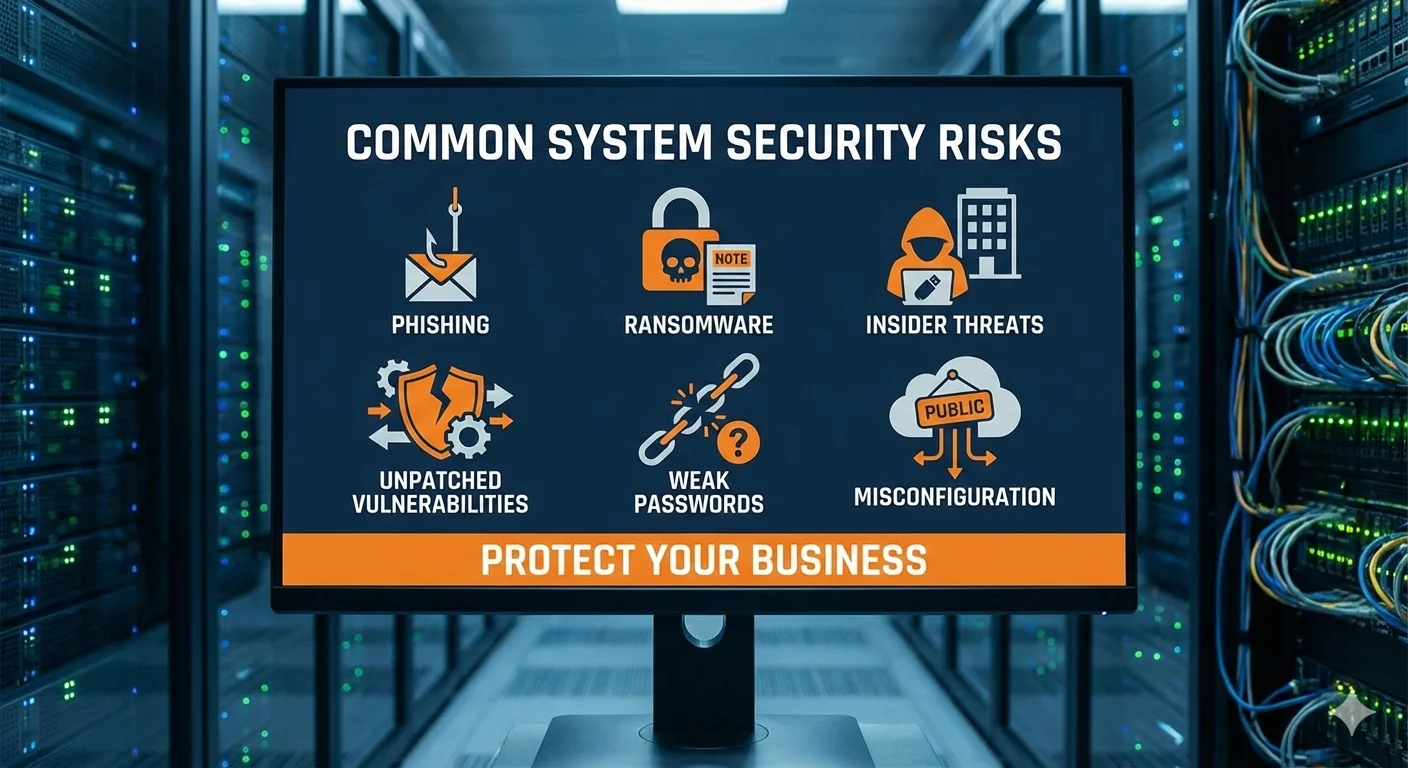
Một số rủi ro phổ biến trong bảo mật hệ thống. Nguồn: FPT Cloud
3. Effective System Security Maintenance Strategies
To protect systems against cyber attacks, enterprises can no longer rely solely on traditional firewalls or antivirus solutions. A comprehensive System Security Maintenance strategy must adopt a multi-layered security approach that integrates people, processes, and technology.
Establishing a Strong Security Baseline
Develop enterprise-wide security policies: Covering password management, access control, and Bring Your Own Device (BYOD) regulations.
Adopt Zero Trust Architecture: Every access request must be verified—no connection is trusted by default, including internal ones.
Regular patch management: Continuously update operating systems, applications, and IoT devices to eliminate known vulnerabilities.
Monitoring & Early Threat Detection
SIEM (Security Information and Event Management): Collects logs from multiple sources and analyzes anomalies.
EDR/XDR (Endpoint / Extended Detection & Response): Provides real-time detection of attacks targeting endpoints, servers, and IoT devices.
AIOps & Machine Learning: Leverages AI to predict and detect abnormal behaviors faster and more accurately than manual monitoring.
Identity & Access Management (IAM)
MFA (Multi-Factor Authentication): Multi-layer login using passwords, OTPs, and biometrics.
RBAC (Role-Based Access Control): Grants permissions based on roles, preventing unnecessary “super-user” privileges.
User lifecycle management: Promptly revoke or remove accounts of departing employees.
Backup & Data Recovery Strategy
3-2-1 backup rule: Three copies of data, stored on two different media types, with one copy kept offline.
Disaster Recovery Plan (DRP): Defines recovery scenarios for incidents such as ransomware attacks, power outages, or natural disasters.
Regular testing: Conduct recovery drills to ensure backup and restoration procedures function as intended.
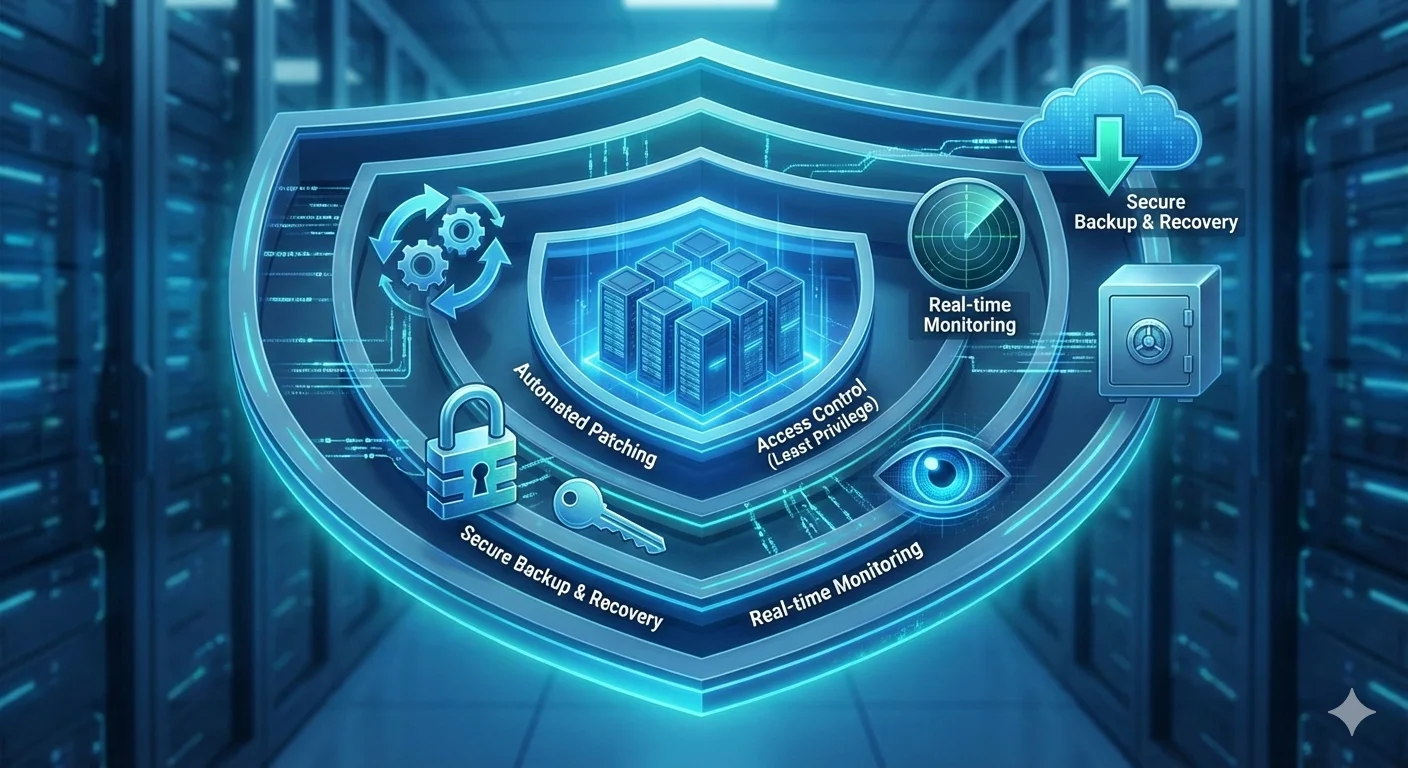
Một số chiến lược System Security Maintenance hiệu quả. Nguồn: VTI Academy
Integrating Security into Operations (SecOps & DevSecOps)
SecOps (Security + Operations): Integrates security and operations teams to enable 24/7 monitoring and incident response.
DevSecOps: Embeds security from the software development stage, including code scanning and container security.
Continuous Monitoring: Systems are monitored continuously rather than through periodic checks.
Security Training & Awareness Enhancement
Phishing simulations: Conduct simulated phishing attacks to assess employee awareness and response.
Regular training programs: Educate employees on risk identification and basic incident handling.
Cybersecurity culture: Foster a mindset where “every employee is a firewall.”
Compliance with Standards & Regulations
ISO/IEC 27001: International standard for information security management.
GDPR / PDPA / HIPAA: Ensure customer data protection in compliance with regional regulations.
NIST Cybersecurity Framework: A globally adopted framework for cybersecurity risk management.
4. The Role of System Security Maintenance in Enterprises
As digital transformation accelerates, IT systems are no longer merely support tools—they have become the backbone of business operations. Consequently, System Security Maintenance plays a critical role, directly impacting an organization’s resilience and long-term viability.
Ensuring Business Continuity
A ransomware attack can shut down systems for hours or even days, resulting in losses of millions of USD. System Security Maintenance minimizes downtime through:
Early detection and incident response
Disaster Recovery Plans (DRP)
Preventive maintenance and regular system checks
Result: Stable and uninterrupted operations, ensuring consistent service delivery to customers.
Protecting Data & Digital Assets
Data—including customer information, product designs, and business strategies—is among an organization’s most valuable assets.
System Security Maintenance enables:
Encryption and secure backup of critical data
Strict access control (IAM, RBAC)
Monitoring and detection of unauthorized access
This helps prevent data loss or leakage to competitors while ensuring compliance with standards such as GDPR and ISO/IEC 27001.
Building Trust with Customers & Partners
Users are increasingly concerned about how organizations handle and protect their data. Weak security directly undermines brand credibility.
Maintaining robust security systems:
Builds customer confidence in products and services
Facilitates partnerships with international clients—especially in markets such as Japan, the EU, and the US, where security regulations are stringent
Vai trò đặc biệt của System Security Maintenance. Nguồn: Sunteco
Cost Reduction for Incident Handling & Compliance Penalties
A single cyberattack can cost 5–10 times more than annual maintenance expenses, including:
Technical incident handling costs
Revenue loss due to system downtime
Compensation and regulatory penalties for data breaches (e.g., GDPR fines can reach up to 4% of global annual revenue)
System Security Maintenance helps enterprises reduce long-term costs by preventing incidents before they occur, rather than responding after damage has been done.
Performance Optimization & Technology Innovation Enablement
Regular security maintenance not only enhances system safety but also improves overall performance:
Eliminates vulnerabilities and system “debris”
Improves processing speed and system stability
Prepares systems for integration with new technologies such as AI, IoT, Cloud, and Blockchain
This enables enterprises to accelerate innovation instead of being constrained by outdated, vulnerable systems.
Legal Compliance & Industry Standards
In industries such as finance, healthcare, logistics, and e-commerce, security compliance is mandatory.
System Security Maintenance enables organizations to:
Pass security audits conducted by regulatory authorities
Meet requirements for contracts with global partners
Minimize the risk of service suspension due to information security violations
5. Security System Maintenance Solutions from BAP Software
With extensive experience delivering projects across Japan, Singapore, Vietnam, and the EU, BAP Software provides specialized O&M (Operations & Maintenance) services for system security—helping enterprises maintain stable operations while complying with international security standards.
BAP’s Technological Strengths
BAP is equipped with a team of AI Engineers, Cloud Architects, and Security Experts, capable of multi-platform implementation:
AI & Machine Learning: Automated anomaly detection, log analysis, and early warning alerts
Cloud Security & Operations: Security management across AWS, Azure, Google Cloud, hybrid and multi-cloud environments
DevSecOps: Security integration throughout the CI/CD pipeline, ensuring protection from the development stage
Zero Trust Architecture: Access control based on the “never trust by default” principle, protecting endpoints through applications
ISO 27001 & Compliance Frameworks: Services operated in alignment with international information security standards
Comprehensive Security System Maintenance Services
BAP offers multi-layered service packages tailored to enterprises of different sizes:
24/7 Monitoring & Operations
Monitoring of logs, performance, and network traffic
Real-time incident detection and response
Transparent dashboards and reports for CTOs and IT Managers
Maintenance & Patch Management
Regular vulnerability scanning
OS, application, and middleware patch updates
Compatibility testing prior to deployment to minimize downtime
Incident Response & Recovery
Incident response playbook development
Rapid system and data recovery after attacks
Root Cause Analysis (RCA) reporting
Compliance & Risk Management
Ensuring compliance with GDPR, HIPAA, PCI-DSS, ISO 27001
Periodic risk assessments and improvement recommendations

Giải pháp áp dụng System Security Maintenance tại BAP. Nguồn: BAP Software
Deployment Process Based on Agile + DevOps + ISO 27001 Standards
BAP applies a hybrid governance model to ensure both flexibility and security:
Agile: Breaks implementation into smaller phases to optimize time and cost.
DevOps: Integrates development and operations to enable rapid updates without service disruption.
ISO 27001: Security is embedded throughout infrastructure, applications, and operations.
Result: Client systems remain secure, stable, and scalable at all times.
Representative Case Studies from BAP Software
Japanese Client (Finance Industry)
Challenge: Risk of customer data leakage and downtime due to legacy systems.
Solution: SIEM + AIOps integration and Zero Trust implementation.
Result: 80% reduction in critical security incidents, near-zero downtime.
Singapore Client (E-commerce)
Challenge: Frequent DDoS attacks and bot scraping on the website.
Solution: Deployment of WAF (Web Application Firewall), Cloudflare, and AI-based alerting systems.
Result: 99.99% uptime, 25% increase in website speed, protection for 5 million transactions per month.
Vietnam Client (Smart Logistics)
Challenge: IoT supply chain vulnerable to attacks and sensor data loss.
Solution: Edge Security combined with blockchain-based data integrity.
Result: Ensured IoT data integrity and reduced manual maintenance costs by 60%.
Conclusion
In the digital era, system security is no longer just a defensive layer—it is a core strategy that enables business continuity, protects brand reputation, and maintains customer trust. As cyberattacks become increasingly sophisticated, the cost of incident recovery can far exceed the investment required for regular security maintenance.
Therefore, Security System Maintenance is no longer optional—it is mandatory for all enterprises, from finance and retail to logistics, manufacturing, and smart cities.
With extensive international project experience, a team of security experts, and processes aligned with Agile + DevOps + ISO 27001, BAP Software is committed to delivering comprehensive Security O&M Services that ensure efficient operations and robust protection.
Start strengthening your system today to stay ahead in the digital era. Contact BAP Software to receive tailored Security System Maintenance solutions aligned with your business model and needs.