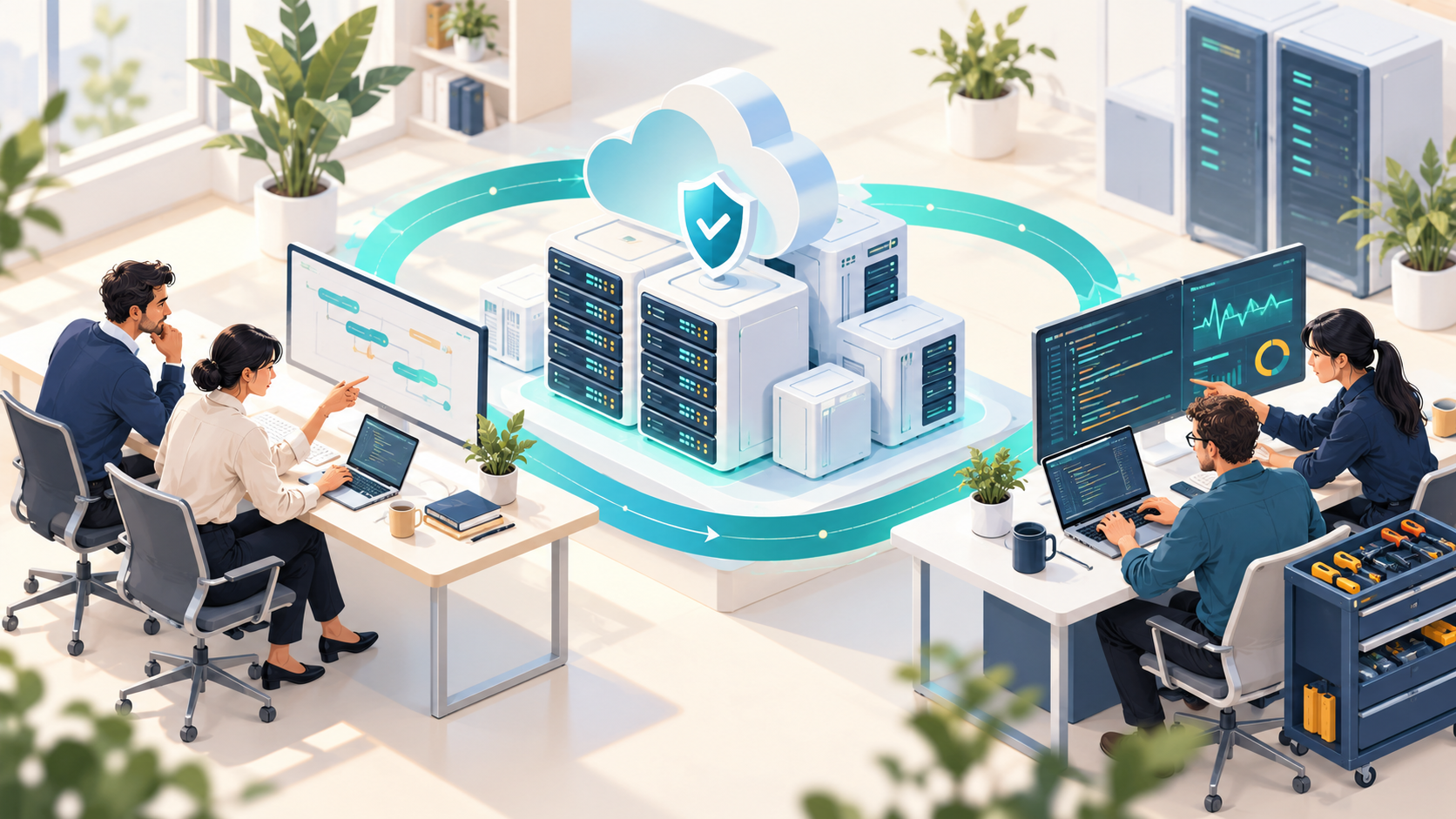
“Who can we trust with our system maintenance?” In 2026, more and more IT managers are asking this question. Limited internal resources, a shortage of skilled engineers, and constant pressure to cut costs — for many companies, the most practical way out of this triple squeeze is outsourcing system maintenance.
This guide walks you through the pros and cons of outsourcing, how to choose the right partner, SLA essentials, and the contract clauses you should never overlook.
What you will learn
- Why outsourcing system maintenance is gaining momentum
- Five key benefits — and the drawbacks you should plan for
- Seven checkpoints for choosing the right maintenance partner
- SLA basics, offshore security measures, and contract pitfalls to avoid
1. Why Outsource System Maintenance Now?
With automation, AI adoption, and cost optimization at the top of IT agendas, outsourcing system maintenance is spreading fast. Three structural challenges are driving this shift.
A deepening IT talent shortage
In Japan, the Ministry of Economy, Trade and Industry (METI) estimates a shortfall of up to around 790,000 IT professionals by 2030. Engineers who can handle maintenance and operations are especially hard to find.
Increasingly complex systems
Cloud migration and microservices keep expanding both the scope of maintenance and the range of technologies teams must support.
The need to focus on core business
IT departments are often so busy keeping systems running that they have little capacity left for digital transformation or new development.
Against this backdrop, outsourcing maintenance to a trusted partner is no longer just a cost-cutting measure — it is increasingly seen as a proactive IT strategy.
2. Five Benefits of Outsourcing System Maintenance
Lower costs and predictable budgets
Outsourcing is usually far cheaper than hiring and training engineers in-house. Offshore maintenance services — for example in Vietnam — can reduce costs by 30–50% compared with hiring domestically. Fixed monthly contracts also minimize surprise expenses and make budgeting easier.
Access to specialist expertise
Maintenance providers have teams experienced across a wide range of technologies, including Java, PHP, Python, and AWS. Legacy systems and modern cloud environments that are hard to support internally become far more manageable in expert hands.
Reliable 24/7 operation
Reputable providers define response and recovery times in a Service Level Agreement (SLA). They can cover nights and weekends — something most in-house teams struggle with — significantly improving availability.
More capacity for core work
Handing off maintenance frees your internal engineers for higher-value work such as digital transformation, new feature development, and AI initiatives — boosting both productivity and the strategic role of IT.
Flexible, scalable capacity
As your business grows or systems are renewed, you can scale your provider’s resources up or down. Getting exactly the engineering capacity you need, when you need it, without hiring risk is a key advantage of outsourcing.
3. Drawbacks to Plan For — and How to Address Them
Outsourcing also comes with risks. The good news: with the right safeguards in place, they are entirely manageable.
| Drawback | What can go wrong | How to address it |
|---|---|---|
| Loss of internal know-how | The system becomes a black box only the vendor understands | Make documentation and regular reporting contractual obligations, and keep the source code under your control |
| Communication overhead | Misunderstandings about requirements and priorities | Appoint a dedicated contact (Bridge SE) and agree on regular meetings and ticketing rules |
| Security concerns | Uncertainty about how sensitive data is handled | Verify ISMS certification, access control policies, and NDA terms in advance |
| Vendor dependency | Switching becomes difficult and negotiating power drops | Specify IP ownership and handover conditions on termination in the contract |
4. How to Choose a Maintenance Partner: Seven Checkpoints
To avoid costly mistakes, make sure you check the following seven points.
| Checkpoint | What to confirm |
|---|---|
| ① Track record | Experience maintaining systems for companies of similar industry and size, with concrete case examples |
| ② Technology coverage | Support for the languages, frameworks, and cloud platforms your systems use |
| ③ SLA clarity | Incident response times, monthly uptime, and escalation flow clearly written into the contract |
| ④ Security | ISMS (ISO/IEC 27001) certification and, for Japanese clients, the Privacy Mark. For offshore providers, review data handling and access policies in detail |
| ⑤ Communication | Language support, reporting frequency, and the strength of project management |
| ⑥ Transparent pricing | Fixed monthly fee or usage-based billing, and clear conditions for any additional charges |
| ⑦ Contract flexibility | Minimum term, termination conditions, and handover support clearly defined |
5. What Is an SLA? The Essentials for Maintenance Contracts
A Service Level Agreement (SLA) is the agreed standard of service quality between a provider and its client. For system maintenance, the key metrics typically include:
| Metric | What it means | Example target |
|---|---|---|
| Availability | Monthly system uptime | 99.9% or higher |
| First response time | Time from incident report to first response | Within 1 hour |
| Recovery time objective (RTO) | Target time from incident to full recovery | 4 hours to 1 business day, by severity |
| Regular reporting | Whether monthly reports are provided, and what they cover | Monthly report plus review meeting |
Watch out
6. Is Offshore Maintenance Secure?
“Is it really safe to hand maintenance to a team overseas?” is one of the most common concerns. Trustworthy offshore partners put the following safeguards in place.
Governance
- ISMS (ISO/IEC 27001) certification: information security managed to an international standard
- NDAs: legally binding protection against information leaks
- Regular security audits: third-party vulnerability assessments and penetration tests
Technical controls
- VPN and dedicated lines: encrypted connections that prevent interception and tampering
- Least-privilege access: engineers receive only the access they strictly need
- Activity logging: a clear record of who did what, and when
Key takeaway
7. Five Contract Pitfalls to Avoid
To avoid unpleasant surprises after signing, confirm these points in advance.
Clearly defined scope
Specify whether maintenance covers only the application layer or also the infrastructure.
Change management process
Agree in advance on the approval flow and billing method for specification changes and additional work.
Intellectual property ownership
Confirm that rights to code fixes and documentation produced during maintenance belong to you.
Termination and handover terms
Specify documentation handover and support during the transition period when the contract ends.
Penalty clauses
Check that compensation for missed SLAs — such as service credits — is included.
8. Why Companies Choose BAP for System Maintenance
BAP (BAP Software) is a Vietnam-based provider of offshore development and maintenance services for Japanese and international clients, with project experience for more than 100 Japanese companies. Clients value our maintenance services for the following strengths.
Smooth communication
Bridge SEs manage each project and act as your point of contact, keeping misunderstandings to a minimum.
SLAs built around your business
We design SLAs flexibly around your operational requirements — no more, no less than you need.
Security-first operations
Your data is protected under a structured information security management framework.
Strong cost performance
Significant cost savings while maintaining quality on par with domestic providers.
Proven partner for system integrators
We support many system integrators facing resource shortages as a reliable delivery partner.
Frequently Asked Questions
Q. How long does it take to switch maintenance providers?
A. It depends on the size of the system, but a transition period of about one to three months — covering system assessment, documentation, and a period of parallel operation — is typical.
Q. Can we outsource maintenance for a small system?
A. Yes. By narrowing the scope and SLA, even small systems can be outsourced at a reasonable cost.
Q. Can you maintain a system developed by another company?
A. Yes. We start by reviewing the source code and documentation, bring them to a maintainable state, and then take over.
Summary: Treat Maintenance Outsourcing as an Investment
- The IT talent shortage and growing system complexity are turning maintenance outsourcing into a strategic move.
- To capture the benefits, plan for the drawbacks and choose your partner carefully.
- Clear contract terms for SLA, scope, IP, and handover are the key to avoiding disputes.
Outsourcing system maintenance is not merely a way to cut costs. With the right partner, you can achieve three things at once: higher quality, lower risk, and better use of your internal team. Moving from “getting by in-house” to “managing together with a trusted partner” is becoming a key source of competitive advantage.
Considering outsourcing your system maintenance? Talk to BAP.
We offer free consultations and quotes at any time. Even if you just want to explore your options or map out the challenges in your current setup, feel free to get in touch.





![[E-learning System Comparison] – The Best 6 E-learning Platforms for Business To Use](https://cdn.bap-software.net/2020/05/e-learning-system-comparison.jpg)