“Isn’t system operation just another word for maintenance?” Even experienced IT teams often use the two terms interchangeably. In reality, operation and maintenance differ in purpose, scope, and the skills they require.
Blurring the line between them leads to familiar problems: incidents bounced between teams, unclear accountability, and unexpected change requests on your invoice. This guide defines both disciplines, compares them side by side, and shows how to draw clear boundaries when you outsource.
What you will learn
- What system operation and system maintenance each involve in practice
- A side-by-side comparison across six key dimensions
- How to split responsibilities across L1–L3 support and governance
- The three boundaries every outsourcing contract should define
1. In Short: Operation Keeps It Running, Maintenance Keeps It Healthy
Let’s start with the simplest definitions.
System Operation
Definition: The day-to-day monitoring, management, and response activities that keep a system running reliably.
Analogy: A production line supervisor — constantly watching the line and stepping in the moment something goes wrong.
System Maintenance
Definition: The technical work of correcting, adapting, and improving a system to preserve and enhance its quality over time.
Analogy: An equipment technician — inspecting machines before they fail, replacing worn parts, and keeping performance up to spec.
Neither works without the other. Think of operation and maintenance as two sides of the same coin: both are needed for a system to stay stable and valuable.
2. What Is System Operation?
Operation work typically falls into four categories.
| Category | Typical tasks | Frequency |
|---|---|---|
| Monitoring | Server uptime checks, CPU/memory usage, error log monitoring, alert handling | 24/7 |
| Incident response | Detection, initial triage, escalation, service restoration, post-incident reporting | As needed |
| Routine operations | Backups, log rotation, batch job management, user account administration | Daily to monthly |
| Security operations | Intrusion detection, vulnerability scanning, security patching, access log analysis | Continuous |
The essence of operation: early detection and rapid response
3. What Is System Maintenance?
The international standard for software maintenance, ISO/IEC 14764, defines four types of maintenance. Here is how they translate into everyday work.
| Type | Purpose | Examples |
|---|---|---|
| Corrective | Fix defects that have been found | Investigating, fixing, and releasing a patch for a production bug |
| Preventive | Resolve latent issues before they cause failures | Paying down technical debt, upgrading the OS and middleware |
| Adaptive | Keep up with a changing environment | Regulatory changes, third-party API updates, cloud platform changes |
| Perfective | Improve performance, usability, and maintainability | Small enhancements based on user feedback, performance tuning |
The essence of maintenance: protecting long-term value
4. Operation vs. Maintenance: Six Key Differences
| Dimension | System operation | System maintenance |
|---|---|---|
| Primary goal | Keep the system up and running | Preserve and improve quality and functionality |
| Timing | Continuous, real-time | Planned (release cycles) or on demand |
| Nature of work | Reactive: respond the moment something happens | Planned: change the system according to a roadmap |
| Key deliverables | Monitoring reports, incident reports, runbook logs | Code fixes, design documents, test results |
| Required skills | Infrastructure, networking, monitoring tools, runbooks | Programming, design, testing, deep codebase knowledge |
| Typical KPIs | Uptime, MTTR, first-contact resolution rate | Defect recurrence rate, change lead time, code quality |
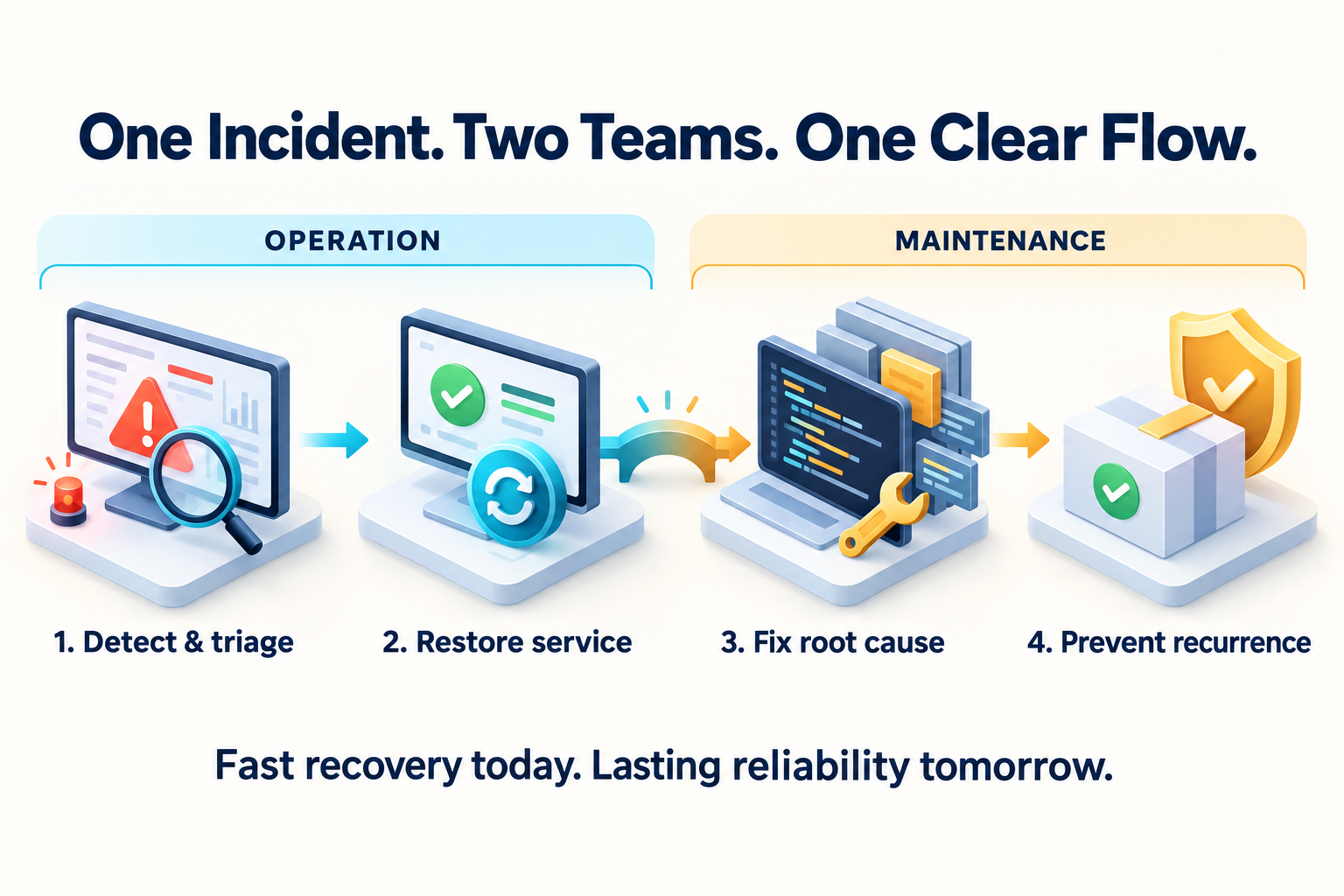
One incident, two phases
Incident handling is where the boundary gets blurry. A single incident usually moves through both teams:
STEP 1|Operation
Detect & triage
Receive the alert and assess the impact
STEP 2|Operation
Restore service
Restart, roll back, or apply a workaround
STEP 3|Maintenance
Root-cause fix
Analyze the code and fix the underlying cause
STEP 4|Maintenance
Prevent recurrence
Test, release, and update the runbook
Practical tip
5. Which Matters More: Operation or Maintenance?
The honest answer: you need both. What changes is the balance, depending on your business situation.
Prioritize operation when…
- Availability directly affects revenue or trust (e-commerce, finance, healthcare)
- The system must run 24/7
- A large user base makes downtime expensive
- You have just launched and need to stabilize first
Prioritize maintenance when…
- Technical debt has built up in a legacy system
- Bug reports are trending upward
- Regulatory or third-party API changes are coming
- Performance is noticeably degrading
Ideally, entrust both to a single partner under an integrated operation and maintenance model. Information, accountability, and escalation then flow without gaps, so you get both speed and quality.
6. Who Does What: A Typical Role Model
Most operation and maintenance teams are organized along these lines.
| Role | Main responsibilities | In-house or outsourced |
|---|---|---|
| Service desk (L1) | First-line inquiries, ticket creation, FAQ responses | Well suited to outsourcing |
| Operations engineer (L2) | Monitoring, incident response, routine tasks, reporting | Well suited to outsourcing |
| Maintenance engineer (L3) | Bug fixes, enhancements, code review, testing | Well suited to outsourcing (offshore works well) |
| Service owner / PMO | SLA management, quality control, budget, strategic decisions | Best kept in-house |
A hybrid model — outsourcing L1–L3 execution while keeping governance and decision-making in-house — usually offers the best balance of cost and quality.
7. Three Boundaries to Define When You Outsource
The single most important step in outsourcing is to define the boundary between operation and maintenance in your contract. Without it, two problems tend to appear.
Common problem #1: The blame game
The operations team says “fixes are maintenance’s job,” the maintenance team says “incidents belong to operations” — and the issue stays unresolved in between.
Common problem #2: Runaway costs
Change requests pile up as items are declared “out of scope.” The root cause is almost always a vague scope definition.
The fix: put three boundaries in writing
| Boundary | What to define |
|---|---|
| ① Scope | Use a flowchart to define where incident response (operation) ends and defect fixing (maintenance) begins |
| ② Time | Set SLA targets — e.g., workaround within X hours (operation), permanent fix within Y business days (maintenance) |
| ③ Cost | Clarify, with examples, what the fixed monthly fee covers and what requires a separate estimate |
Pre-contract checklist
- Are support hours agreed (business hours only, or 24/7)?
- Are severity levels defined, with response and resolution targets for each?
- Are reporting frequency, format, and review meetings agreed?
- Are documentation, source code ownership, and handover conditions clear?
8. BAP’s Integrated Operation & Maintenance Service
At BAP, a single team handles both operation and maintenance under our integrated O&M service. This approach delivers three clear advantages.
① Continuous knowledge
Patterns spotted during operation feed directly into maintenance fixes. The team that knows the system best is the one that fixes it.
② Less coordination overhead
No more managing separate vendors for operation and maintenance — your internal coordination effort drops significantly.
③ Single point of accountability
No debates about whose responsibility an issue is. Service quality is owned end to end.
A dedicated Bridge SE acts as your single point of contact, so you get clear communication along with the cost advantages of offshore delivery — without compromising on quality.
Frequently Asked Questions
Q. Can operation and maintenance be outsourced to different vendors?
A. Yes, but you will need very precise definitions of scope and hand-off procedures. Using one partner for both is the most reliable way to avoid the blame game.
Q. Can we outsource O&M for a system that is already running?
A. Yes. The usual approach is to start with a system assessment and documentation handover, then transition responsibilities in phases.
Q. Are time zones and language a problem with offshore O&M?
A. Not when it is set up properly. A Bridge SE serves as your contact, and support hours and escalation rules are agreed in the SLA.
Summary: Understanding the Difference Is the First Step
- Operation keeps today’s system from going down.
- Maintenance keeps tomorrow’s system from degrading.
- When outsourcing, define the three boundaries — scope, time, and cost — in your contract.
Design your team around this distinction and translate responsibilities into clear contract terms. That is the foundation of reliable system management.
Rethinking your O&M setup? Talk to BAP.
We will propose the right operation and maintenance structure for your system size, industry, and budget — free of charge. Feel free to reach out, even if you are just starting to map out your challenges.