GENERATIVE AI × SYSTEM INTEGRATION
Bring Generative AI into
Your Existing Enterprise Systems
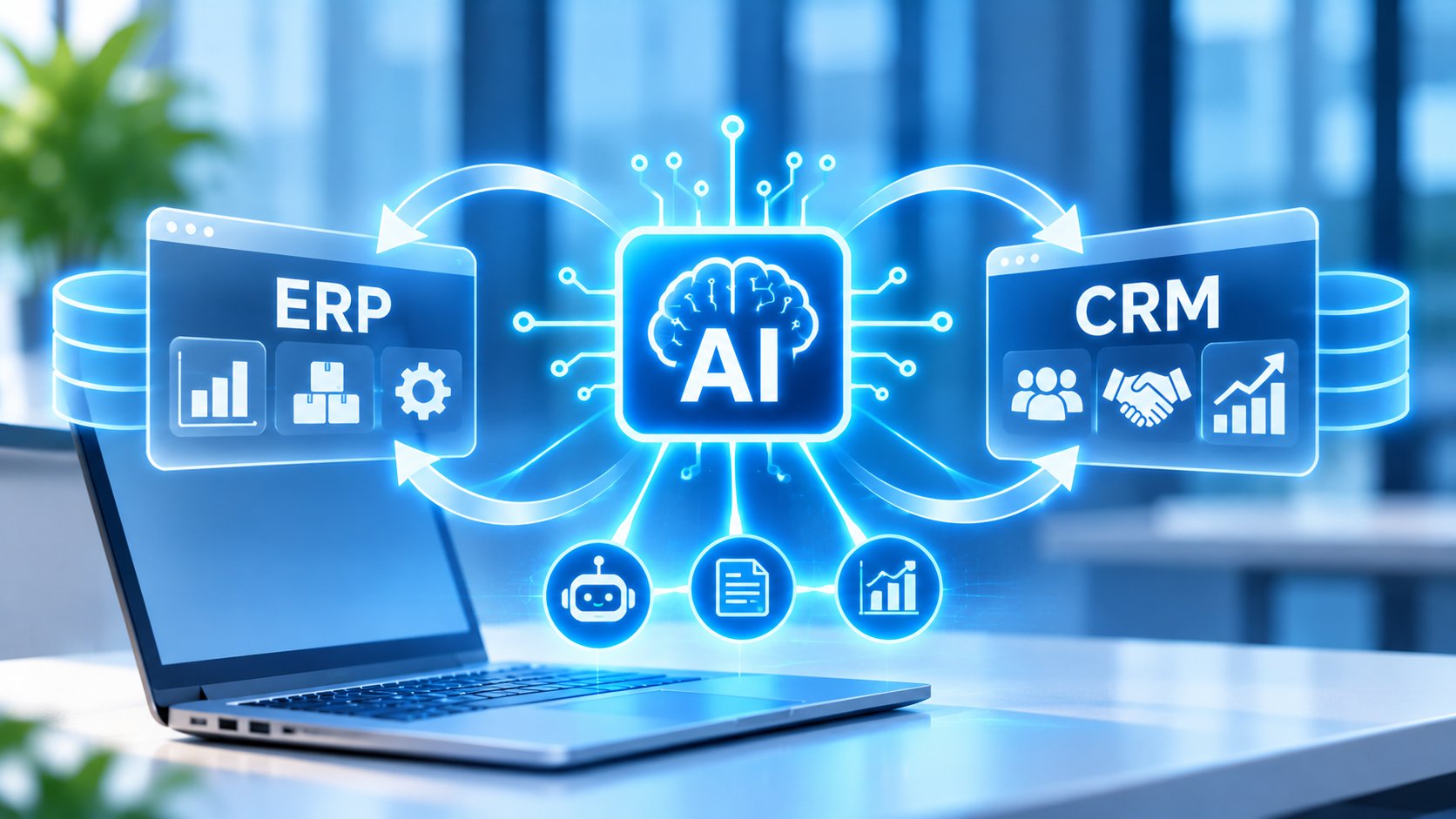
Connect ERP, CRM, and enterprise databases to unlock more value from business data.
→
→
Extend your existing technology investments with AI capabilities, one step at a time.
ENTERPRISE AI / SYSTEM INTEGRATION
“We want to adopt generative AI, but do we need to replace our existing ERP or CRM system first?”
As businesses explore generative AI, many are looking for ways to connect AI capabilities with the enterprise applications and internal data they already rely on. However, questions about system compatibility, security, implementation costs, and operational complexity often slow down adoption.
The good news is that adopting generative AI does not necessarily require replacing existing enterprise software. Depending on system architecture and available interfaces, organizations can use APIs and data integration layers to introduce AI-powered features while preserving their current business applications.
This article explains how to integrate generative AI with existing systems, including ERP, CRM, and enterprise databases. We also explore integration architectures, business use cases, security considerations, and a practical roadmap from proof of concept (PoC) to production.
What You Will Learn
- Why connecting generative AI to existing enterprise systems matters
- How to integrate AI with ERP, CRM, and internal databases
- Common API and data integration architectures
- Realistic applications across sales, back-office operations, and manufacturing
- Key considerations for security, access control, and data governance
- A five-step roadmap for enterprise AI integration
01. Why Integrate Generative AI with Existing Enterprise Systems?
Introducing a standalone AI chatbot may not deliver the business value an organization expects. Much of the information employees need is already stored in enterprise resource planning (ERP), customer relationship management (CRM), inventory management, sales management, and internal database systems.
By connecting generative AI to these systems, businesses can use existing operational data to support information retrieval, document generation, customer service, and other everyday tasks.
Maximize existing technology investments
Replacing an enterprise system can involve extensive data migration, workflow redesign, employee training, and operational disruption. Integrating AI into an existing environment may allow organizations to introduce targeted capabilities without undertaking a full system replacement.
Make enterprise data more accessible
For example, an AI application connected to CRM data could retrieve customer interaction history, summarize an opportunity, and suggest follow-up actions for a sales representative. Access to relevant business data enables more context-aware assistance than a general-purpose AI application operating without that information.
Reduce repetitive administrative work
Employees often switch between multiple systems to collect information, prepare reports, and update records. Generative AI can assist with summarization, drafting, and organizing retrieved information, helping reduce repetitive manual work.
Key consideration
The value of enterprise AI integration depends on more than model performance. Organizations must also ensure that AI applications can access the right data, respect existing business rules, and fit naturally into established workflows.
02. How to Connect Generative AI with ERP, CRM, and Enterprise Databases
The right integration method depends on the existing system architecture, API availability, data formats, security requirements, and the need for real-time information.
Integrating generative AI with ERP
ERP systems manage critical business processes such as procurement, sales, inventory, finance, and accounting. Connecting AI applications to ERP data can help authorized employees retrieve information through natural-language interfaces and prepare summaries or reports.
For business-critical figures such as inventory quantities, financial balances, and transaction totals, the application should retrieve verified values through approved ERP APIs or database services rather than asking a language model to estimate them.
Integrating generative AI with CRM
CRM platforms store customer profiles, sales opportunities, activity records, and service interactions. Integrating generative AI with platforms such as Salesforce can support opportunity summaries, sales activity documentation, customer inquiry classification, and response drafting.
When AI-enabled workflows involve updating customer records or sending external communications, organizations should implement appropriate approval mechanisms, access controls, and audit logs.
Connecting AI to enterprise databases
Enterprise databases contain structured information such as product codes, inventory levels, orders, and operational records. These data sources require different handling from unstructured documents.
For structured data, controlled SQL queries or application APIs are often appropriate. For unstructured information such as manuals, meeting notes, and internal policies, retrieval-augmented generation (RAG) may be more suitable.
| System | Typical Data | Potential AI Applications |
|---|---|---|
| ERP | Inventory, purchasing, sales, finance | Business information retrieval and reporting assistance |
| CRM | Customers, opportunities, interaction history | Opportunity summaries and sales assistance |
| Enterprise Databases | Product information and operational records | Natural-language information retrieval |
| Document Management | PDFs, manuals, internal FAQs | Document search and grounded AI responses |
03. API Integration and Data Integration: Common Architecture Patterns
When connecting generative AI with enterprise applications, it is often preferable to introduce an integration layer rather than giving the AI model unrestricted direct access to business systems.
This layer can handle authentication, authorization, data transformation, approved tool execution, and logging.
Pattern 1: API-based integration
API integration allows AI-enabled applications to retrieve or update information through interfaces provided by existing systems. This approach is particularly useful when applications need current business data or must follow established transaction and validation rules.
Pattern 2: Data integration platforms
ETL, ELT, and other data integration technologies can collect and prepare information from multiple systems. This approach is useful when organizations need consolidated data for cross-system reporting, analysis, or AI-assisted insights.
Pattern 3: RAG and enterprise search
For unstructured content such as PDFs, operating manuals, and internal FAQs, organizations can build a search index that retrieves relevant documents and supplies them as context to a language model.
These patterns can also be combined. For example, an AI application might retrieve current inventory figures through an ERP API while searching related operating procedures through a RAG system. The application can then present both types of information in a single response.

SYSTEM INTEGRATION ARCHITECTURE
Enterprise Generative AI Integration Architecture
↕
API & Data Integration Layer
Authentication · Access Control · Data Processing · Audit Logging
↕
Generative AI Application
LLM · RAG · Business Logic · Response Generation
↕
Employees · Managers · Business Users
Enterprise Portal · Chat Interface · Business Applications
This architecture is illustrative. Actual implementations should account for system limitations, data sensitivity, performance requirements, and the organization’s cloud or on-premises deployment policies.
04. Enterprise Use Cases: Sales, Back-Office Operations, and Manufacturing
Generative AI integration can support different business functions depending on the systems involved and the operational problems being addressed.
Sales: AI-assisted CRM workflows
An AI application can retrieve customer information, previous interactions, and opportunity details from a CRM platform to generate concise summaries and suggest possible next steps.
This can help sales representatives spend less time gathering information and more time engaging with customers and preparing proposals.
Back-office operations: Internal support and employee assistance
HR, administration, and IT teams often respond to recurring questions using internal policies, operating procedures, and support documentation.
By integrating generative AI with document repositories and approved business APIs, organizations can provide employees with relevant guidance and assist with routine support requests.
Manufacturing: Production and quality information assistance
Manufacturing organizations often manage production, equipment, and quality data across manufacturing execution systems (MES), ERP platforms, and quality management applications.
Connecting generative AI with these systems can help authorized employees retrieve production information, organize quality-related records, and prepare operational summaries.
However, critical production figures and quality measurements should always come from authoritative systems rather than AI-generated estimates. Safety-critical decisions must remain subject to approved procedures and qualified human oversight.
A practical design principle
Use enterprise systems for reliable data storage, calculations, and transactions. Use generative AI for language understanding, summarization, drafting, and conversational interaction. Combining these strengths is often more practical than asking AI to perform every function independently.
Note: These examples illustrate potential enterprise applications and do not represent verified results from specific BAP client projects.
05. Security, Access Control, and Data Governance Considerations
Enterprise systems often contain sensitive information, including customer records, employee data, financial transactions, and proprietary technical documents. Security and governance must therefore be addressed from the beginning of an AI integration project.
Identity and access management
AI applications should not allow employees to retrieve information they are not authorized to access in the original system. Authentication, role-based permissions, and source-system authorization policies should be enforced consistently.
Data transmission to external AI services
When using third-party AI services, organizations need to understand what data is transmitted, how it is processed, and what retention and usage terms apply. Sensitive information may require masking, filtering, or additional restrictions.
Audit logging and traceability
Organizations should be able to trace relevant user requests, data access, and actions performed through AI-enabled applications. Logging and monitoring help support incident investigation, operational control, and compliance requirements.
Preventing unauthorized actions and prompt injection
If an AI application can update records, send emails, or trigger business transactions, its permissions should be limited to approved operations. Important actions may require explicit human confirmation.
Applications should also be designed to resist prompt injection, where malicious instructions embedded in documents or retrieved content attempt to manipulate AI behavior.
Whether deployed in the cloud, a private environment, or on-premises, enterprise AI solutions require appropriate security architecture and ongoing governance.
06. A Five-Step Roadmap for Integrating Generative AI with Existing Systems
Successful enterprise AI integration requires more than technical experimentation. Organizations should validate business objectives, existing system constraints, and operational requirements before scaling implementation.
STEP 01 | Define Business Objectives and Use Cases
Identify the processes to improve, such as information retrieval, document drafting, or customer support. Define measurable indicators, including processing time, response quality, or employee productivity.
STEP 02 | Assess Existing Systems and Data
Review ERP, CRM, databases, and other relevant systems. Confirm API availability, data structures, access permissions, integration constraints, and operational dependencies.
STEP 03 | Design Integration and Validate Through a PoC
Select suitable integration approaches, such as APIs, data pipelines, or RAG. Build a limited proof of concept to evaluate technical feasibility and business value.
STEP 04 | Implement, Integrate, and Test
Implement authentication, authorization, exception handling, monitoring, and audit logging. Test data accuracy, system performance, and the safety of business operations.
STEP 05 | Deploy, Monitor, and Improve
Start with a controlled user group, monitor response quality and operating costs, collect feedback, and expand the solution based on validated results.
IMPLEMENTATION ROADMAP
Five Steps to Enterprise AI Integration
→
Assess Systems
→
Build PoC
→
Integrate & Test
→
Deploy & Improve
Build on existing systems, validate results, and scale progressively.
During the PoC phase, organizations should evaluate more than AI response quality. Data retrieval accuracy, API response times, integration reliability, permission enforcement, and potential impacts on existing operations are equally important.
07. Enterprise Generative AI and System Integration Services by BAP
Integrating generative AI into existing enterprise systems requires more than selecting an AI model. It also demands an understanding of business applications, data architecture, API design, security, and long-term operational requirements.
BAP supports enterprise software development across generative AI, AI agents, ERP, CRM, web applications, and cloud technologies. By combining these capabilities, we help organizations explore AI solutions that build on their existing technology environments.
With development teams in Japan and Vietnam, BAP can support projects from requirements analysis and system assessment to API integration design, PoC development, implementation, deployment, and ongoing maintenance, depending on project scope.
BAP SOLUTION JAPAN
Looking to Integrate Generative AI with Your Existing Systems?
Whether you want to connect AI with ERP data, integrate generative AI into Salesforce, or add AI capabilities to existing business applications without a full system replacement, BAP can help you evaluate practical implementation approaches.
Contact BAP to discuss your current system environment, business requirements, and potential next steps for enterprise AI integration.
Conclusion: Integrating generative AI with existing ERP, CRM, and enterprise database systems can make business information more accessible and support more efficient workflows. Through suitable combinations of APIs, data integration platforms, and RAG, organizations can introduce AI capabilities without necessarily replacing their existing software. A successful implementation starts with clear business objectives, careful system assessment, secure integration design, and practical validation through a PoC.