AI DEVELOPMENT OUTSOURCING GUIDE
How to Outsource
AI System Development
A practical guide to selecting development partners, evaluating costs, reviewing contracts, and planning long-term operations.
→
→
→
Look beyond price: evaluate technical expertise, business understanding, delivery capabilities, and ongoing support.
AI DEVELOPMENT / VENDOR SELECTION
“We want to outsource AI development, but how do we choose the right development company?”
As businesses increasingly explore generative AI and AI agents, many organizations face challenges in developing and maintaining AI systems entirely in-house. Outsourcing offers access to specialized expertise and additional engineering capacity without requiring companies to build every capability internally.
However, AI development providers differ significantly in their technical capabilities, industry experience, delivery models, and operational support. Some specialize in AI prototypes, while others can handle enterprise system integration, production deployment, and long-term maintenance.
This article explains how to outsource AI system development effectively, covering project preparation, vendor evaluation, development costs, contractual considerations, and the process from initial consultation to production operations.
What You Will Learn
- What to prepare before outsourcing AI development
- The benefits and potential risks of outsourcing
- Seven criteria for selecting an AI development company
- What influences AI development costs and how to compare quotations
- Important contractual terms to review before signing
- The typical outsourcing process, from consultation to production
01. What to Prepare Before Outsourcing AI System Development
Before contacting an AI development company, organizations should first define the business problem they want to solve.
For example, a requirement such as “We want to implement generative AI” does not provide enough information to determine the necessary functionality or project scope.
In contrast, a more specific objective, such as “We want employees to search internal policies and operational manuals more efficiently to reduce support response times,” provides a clearer foundation for identifying data requirements, user roles, and success criteria.
The following information should be considered before requesting a proposal.
| Category | Questions to Consider |
|---|---|
| Business Objectives | Which business processes need improvement? |
| Target Users | Will the system serve employees or customers? |
| Data Sources | PDFs, Excel files, CRM, ERP, or internal databases? |
| Required Features | Search, summarization, content generation, or workflow execution? |
| Security | What sensitive data and access restrictions are involved? |
| Timeline | When should validation and production deployment begin? |
| Budget | What are the expected development and operating budgets? |
Not every requirement needs to be finalized before the first discussion. However, communicating clear business objectives and priorities allows development partners to provide more relevant technical recommendations and realistic proposals.
Practical Recommendation
Instead of focusing only on what the AI system should do, define what measurable business improvement would make the project successful.
02. Benefits and Challenges of Outsourcing AI Development
One of the main benefits of outsourcing AI development is access to specialized engineering expertise.
Enterprise AI systems often require multiple technologies, including generative AI, RAG, API integration, cloud infrastructure, databases, and security. Building and maintaining all these capabilities internally can be difficult, especially when engineering resources are limited.
Key Benefits
- Access to specialized AI engineering expertise
- Additional development capacity
- Support for complex, multi-technology solutions
- Flexible team structures based on project requirements
Potential Challenges
- Misalignment on business requirements
- Unclear data ownership and security responsibilities
- Unexpected additional development or maintenance costs
- Dependency on specific technologies or vendors
The goal should not be simply to delegate coding tasks. Organizations should look for a development partner capable of understanding business requirements and supporting the system throughout its lifecycle.
03. Seven Key Criteria for Choosing an AI Development Company
When comparing AI development vendors, organizations should evaluate more than the proposed development cost. Business understanding, technical capabilities, quality assurance, communication, and ongoing support are equally important.
01 | Relevant Project Experience
Building an AI demonstration is different from delivering a production-grade enterprise application. Ask vendors to explain the business challenges they addressed and their responsibilities in previous projects.
02 | Enterprise System Integration Capabilities
If the project requires integration with ERP, CRM, databases, or identity management systems, experience in backend development, APIs, and cloud architecture is essential.
03 | Requirements Analysis and Consulting
A capable partner should help clarify functional requirements, priorities, and technical constraints, even when the initial specification is incomplete.
04 | Security and Data Protection
Verify that the vendor can explain data storage, external AI service usage, access control, and audit logging in concrete terms.
05 | AI Quality Evaluation
Ask how the vendor will evaluate answer accuracy, source attribution, incorrect outputs, response time, and other quality indicators relevant to the application.
06 | Project Management and Communication
Review reporting methods, issue tracking, change request procedures, and communication responsibilities. For offshore development, clear coordination between local project managers and engineering teams is especially important.
07 | Maintenance and Long-Term Support
Confirm whether the vendor can support model updates, API changes, incident response, and ongoing system improvements after deployment.
VENDOR SELECTION CHECKLIST
Seven Criteria for Evaluating AI Development Partners
Integration
Requirements
Security
Quality
Communication
Maintenance
Evaluate the vendor’s ability to deliver and maintain the complete solution, not just its initial quotation.
04. What Determines AI System Development Costs?
AI development costs depend on more than the number of application screens or features.
For enterprise AI projects, factors such as data preparation, system integration, security requirements, quality assurance, and infrastructure can significantly affect the overall development effort.
| Cost Factor | Key Considerations |
|---|---|
| Development Scope | PoC only or full production development |
| AI Functionality | Chatbots, RAG, AI agents, and workflow automation |
| Data Preparation | Collection, transformation, and cleansing |
| System Integration | Number of APIs and legacy system constraints |
| Security | Authentication, permissions, and audit logs |
| Quality Requirements | AI evaluation, testing, and monitoring |
| Infrastructure | Cloud, on-premises, or GPU environments |
| Maintenance | Incident response, API updates, and improvements |
For example, a simple FAQ chatbot and an AI application with document retrieval, role-based access control, and CRM integration may both be described as “AI chatbot development,” but their implementation complexity can be very different.
In addition to initial development costs, organizations may need to budget for AI API usage, cloud infrastructure, monitoring, and ongoing maintenance.
How to Compare AI Development Quotations
- Are included features and excluded activities clearly defined?
- Does the quotation include requirements analysis, testing, and deployment?
- Are third-party AI services and infrastructure billed separately?
- How are additional costs calculated when requirements change?
- Are maintenance costs separated from initial development costs?
Cost Evaluation Tip
Compare quotations based on the same project scope, deliverables, and operational requirements. A lower initial price does not necessarily indicate a lower total cost of ownership.
05. Important Contractual Considerations When Outsourcing AI Development
Before signing an AI development agreement, both the client and development provider should establish a shared understanding of responsibilities, deliverables, and project boundaries.
Project Scope and Deliverables
Define which documents and assets will be delivered, including requirements specifications, design documentation, source code, test results, and operational manuals.
Change Requests and Additional Costs
Clarify how new requirements will be estimated, approved, and reflected in project schedules and costs.
Intellectual Property and Third-Party Technologies
Confirm ownership and licensing arrangements for custom-developed software. Where AI models, open-source components, or external APIs are used, review the applicable third-party terms.
Data Handling and Confidentiality
Specify how confidential information is managed, what data may be sent to external services, who can access the data, and how information will be returned or deleted when the contract ends.
Acceptance Testing and Quality Criteria
AI outputs may vary, even when users submit similar requests. Therefore, acceptance criteria should be based on agreed evaluation datasets, test procedures, and measurable performance expectations where appropriate.
Maintenance and Incident Response
Define support hours, incident priorities, bug-fixing responsibilities, and how future enhancements will be handled.
Note: Contract requirements vary by jurisdiction, project structure, and outsourcing model. Legal professionals should review agreements when necessary.
06. The AI Development Outsourcing Process: From Consultation to Production
Enterprise AI outsourcing projects typically follow several stages, although the exact process depends on technical complexity and business requirements.
STEP 01 | Business Analysis and Initial Consultation
Share business challenges, target users, available data, budget expectations, and preferred timelines.
STEP 02 | Requirements Definition and Technical Planning
Work with the development partner to define features and compare options such as existing AI services, custom development, and API integration.
STEP 03 | Proof of Concept (PoC)
When technical feasibility or AI output quality is uncertain, validate the proposed approach using a limited dataset and a clearly defined scope.
STEP 04 | Production Development and Integration
Develop the user interface, backend, AI features, data connections, authentication, and access controls, followed by appropriate testing.
STEP 05 | Deployment and Continuous Improvement
After deployment, monitor usage, response quality, system stability, and operating costs. Use feedback to prioritize improvements.
OUTSOURCING ROADMAP
Five Steps to Outsource AI System Development
→
Requirements
→
PoC
→
Development
→
Operations
Start with clear objectives, validate uncertainties, and move toward sustainable production operations.
Not every project requires a separate PoC. When the technical approach is well understood and risks are manageable, organizations may simplify the process based on their specific requirements.
07. How BAP Supports Enterprise AI Development and Outsourcing
Developing enterprise AI systems requires more than expertise in generative AI models. Successful implementation also depends on understanding business processes, integrating existing systems, managing data securely, and maintaining reliable operations.
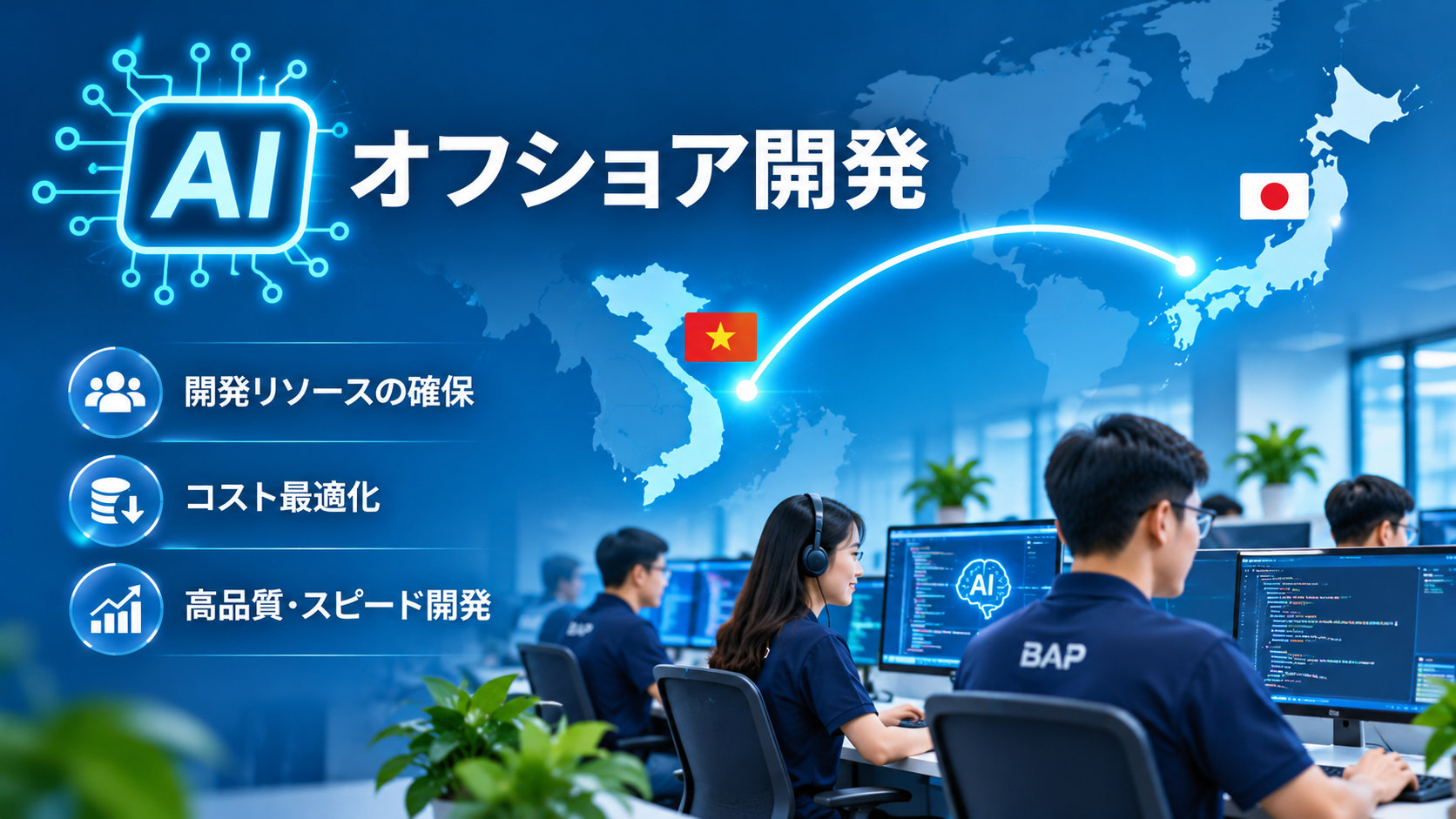
BAP supports enterprise software development through its engineering teams in Japan and Vietnam, covering generative AI, AI agents, RAG, web applications, and ERP/CRM integration.
Depending on project requirements, BAP can support organizations from requirements analysis and PoC development through production implementation, deployment, and ongoing maintenance.
BAP SOLUTION JAPAN
Looking for a Reliable AI Development Partner?
Whether you are exploring the feasibility of an AI solution, planning integration with existing enterprise systems, or comparing development partners, BAP can help you evaluate the available options.
Our team works with organizations to understand business requirements, assess technical feasibility, and define an appropriate development approach.
Contact BAP to discuss your AI development requirements and potential next steps.
Conclusion: Outsourcing AI system development requires careful consideration of more than price. Business understanding, technical expertise, system integration, AI quality evaluation, security, and ongoing maintenance all influence project outcomes. By defining objectives, comparing vendors under consistent conditions, and establishing clear contractual responsibilities, organizations can reduce project risks and make more informed outsourcing decisions. Selecting a development partner that understands both enterprise technology and operational requirements is an important step toward building practical, maintainable AI solutions.